A Visit from an Ancestral Ghost: A Writing Teacher on Telling History
Updated: 3 hours ago
When we dreamed up Her Voice at the Table almost six years ago, we knew we wanted a more formal space to dream, think, and collaborate on the intersections between student writing and well-being. What, we wondered, is the promise of writing?
The most fulfilling (and difficult!) part of this process has been doing the hard work of, well, actually writing–the very work we ask our students to do every day. Putting ourselves in the writing seat has reminded us just how scary and rewarding writing can be.
Many of our colleagues are in fact always writing–poetry, short stories, novels, academic articles–and thus serve as models of lifelong writers for our students. On this Veterans Day, we wanted to feature the writing of one such colleague, George Nicolas Rodriguez, who recently wrote a historically-inspired World War I story about his great-grandfather Amado Robledo. Initially, this piece was not written for publication but rather for his own family’s enjoyment–a private piece of love for them. We were so touched by this piece, though, that we asked him to revise for a wider audience.
Below is a brief interview with George, followed by his moving tale of Amado Robledo.
Interview with George Nicolas Rodriguez

Her Voice at the Table: Can you tell us a little about your path towards writing–both as a writer and eventually as a teacher?
GNR: I was a full year behind the other students my age in elementary school. I’m incredibly grateful to my– very, very patient– parents who would take shifts sitting with me at night reading Mary Pope Osborne’s Magic Treehouse series to help me get a better handle on literacy. However, despite my difficulties with the written word, I could not escape the overwhelming force of my imagination breathing life into the stories of the people around me. On my father’s side, my grandparents and uncles were Cuban exiles who had risked life and limb to start over in the United States. While my mother’s parents were both life-long educators who had taught just about every child in their small town of Weslaco, Texas. I had no shortage of inspiration around me and, with both parents running their own small business, a lot of time to sit on the floor of my grandparents’ living room and just talk them through the adventures in my head.
It took a long time for me to fall in love with reading, probably until my sophomore year of high school. I wasn’t good at it, so I didn’t like it. Telling stories though? That was one of those God-given talents I just couldn’t escape. By the end of undergrad, I finally realized I could marry my love of reading with my passion for storytelling. I clearly remember that first surge of youthful confidence in finally figuring out what I wanted to be “when I grew up,” but I felt like I needed more training. Continuing onto graduate school at my alma mater of Seton Hall would be the next logical step, however, I simply could not afford to take on more student loan debt. I applied for the teaching assistant fellowship program where I would teach in the mornings, take classes at night, and the rest is history.
Her Voice at the Table: We know you’ve encouraged/inspired/mentored any number of writers here at Ursuline. Can you tell us about a teacher or two who has been a key mentor for you?
GNR: In high school, my top three favorite subjects were ranked in the following order: theology, history, then English. Part of that came down to me being on my journey to falling in love with reading, but the other part was that I just had a great lineup of strong teachers. Father Leise, SJ; Mr. DuRoss; Father Hooks, SJ; and Mr. Harrington were my spiritual stewards through a time when I was asking difficult questions as well as being difficult about the answers. Those four men each gave me different tools that I’ve used on my journey both in and out of my faith life. I particularly need to highlight the mentorship of Mr. Harrington, as he taught me how to merge my love of fantasy and science fiction to wider philosophies about the nature of existence. To this day, the classes I teach are directly inspired by the lessons I learned in that class. In my senior year, I spent nearly every lunch period in his office just chatting about theology in Star Wars or theology in The Lord of the Rings or theology in the comic books we were reading. It’s a little strange now that we’re both teachers, but every year on Ranger Day I set aside a good chunk of time for us to chat and it’s like picking up right where we left off every time.

Her Voice at the Table: Perfectionism and imposter syndrome are alive and well here at Ursuline. How do you help your student writers push past creative self-doubt?
GNR: I want to be clear that I can’t take credit for this idea, as it comes from the mind of horror director Zach Cregger, but I’ve been using it with students in my novel writing class as well as in my own writing. It’s generally true that writers want their first drafts to be good, but our wonderful UA students put an immense amount of pressure on themselves for that draft to be more than just “good,” they want it to be immaculate. Instead of alleviating the pressure by removing flaws from the writing, Cregger’s approach is to actually remove the self from the flaws. He calls this “elfing.” The idea is that the first draft is not actually written by the author. Instead, the writer must approach the situation with the understanding that they have hired an elf, a rather stupid elf in fact, that will be the one drafting that first pass at the story. In that “elf draft” there will be grammatical mistakes, disconnected scenes, hokey dialogue, and the story will be a complete mess, but that’s okay because the stupid elf wrote it. He’s not very bright and he certainly isn’t being paid, so the writer must accept that first draft in whatever state it arrives. Obviously, on a literal level the elf and the writer are one and the same. However, that one layer of separation is often enough to get students to let go of their own anxieties and get words on the page. A little bit of ego death goes a long way!
Her Voice at the Table: What are you working on right now? Or–what kind of writing projects are in your near future?
GNR: I’ve been working on a Southern Gothic Fantasy novel for a few years now, though most of that writing happens over the course of the summer or in the nooks and crannies of long weekends or breaks. Separately from that though, almost all of my early writing from middle school up through grad school has actually been historical fiction and this shorter research project has really inspired me to get back to my roots with more historically inspired pieces. I find that I work best when I’ve got a character to flesh out or a particular scene to write around. My godfather flew a reconnaissance aircraft during the Vietnam War and that’s really caught my interest lately. I've been talking to him, listening to those stories with both academic and imaginative curiosity. I typically don’t do biographical writing, but I’ve told him if he ever wants to get it all down in a memoir I’d be happy to take that on. Mostly though, I’m just keeping my ear to the rail looking for whatever inspires me, the unreal, the surreal, and the too real.
Who was Amado Robledo?
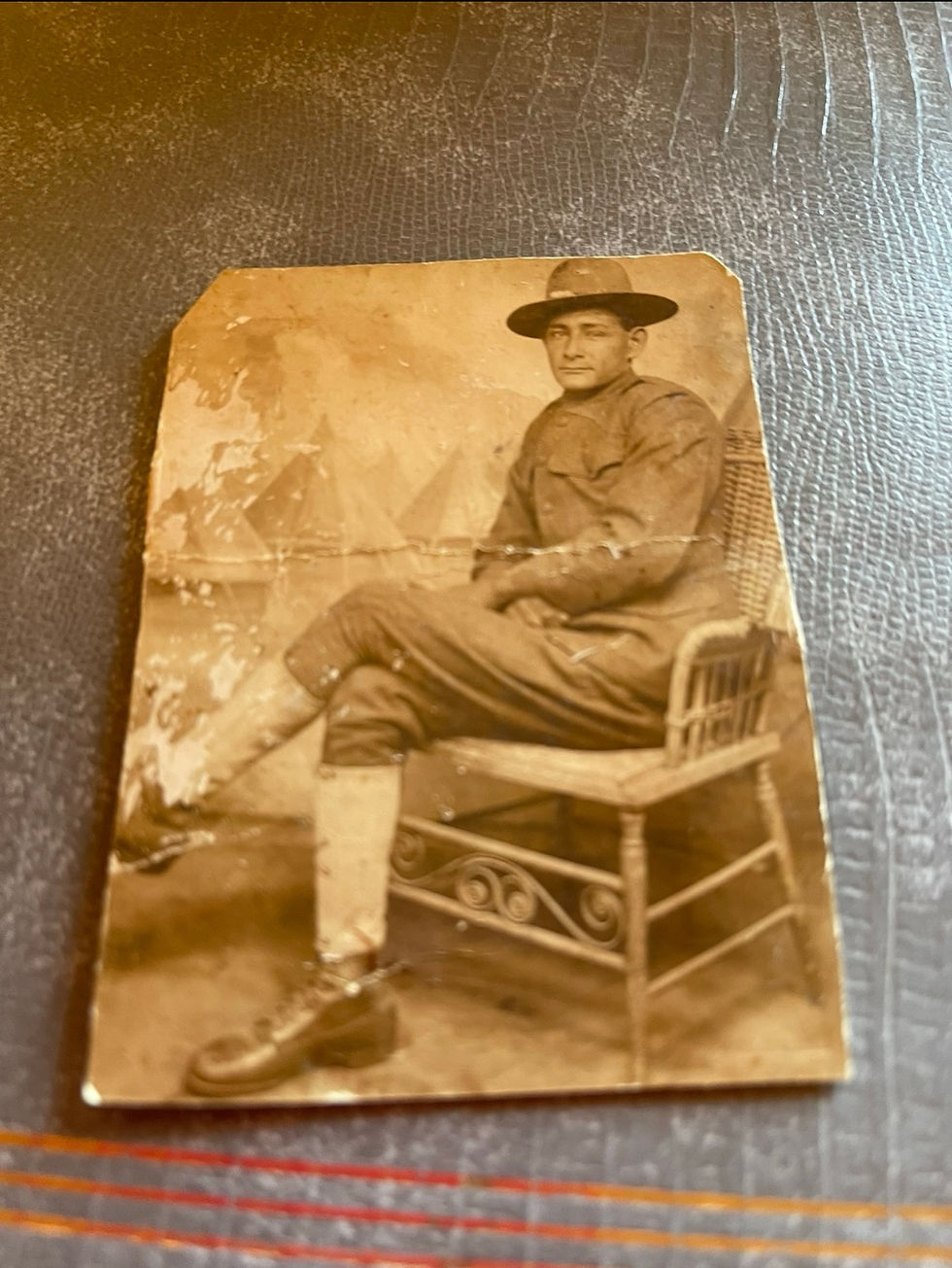
As September came to a close, I was visited–with some frequency–by a ghost. Over the course of several nights, I saw my great-grandfather Amado Robledo in my dreams. Even now, a full month removed, the image of him in my mind's eye remains so vivid. He came to me as an older man, tall and well dressed in a suit, with circular glasses and a lovely wooden cane. I would see him at my parents' ranch at a vague sort of family gathering where he watches on as people talk and go about their business. In these dreams, I always approach him to try and talk to him, but never can.
I don't know how much stock I put in dreams. If leading neurologists don't understand what they are, then I certainly won't make any claims to. However, as a great lover of stories, I just couldn't let the thread go. Our births are separated by one hundred years of history (1898 and 1998, respectively) and while I was aware Robledo served overseas, that was about the extent of my personal knowledge. So, I decided to start my research at the place where I'm most comfortable: that muddy, blood-soaked theatre of war that has lived right alongside the Middle Ages as a historical period I never tire of learning about: World War I. It took some digging, but I was able to find the service record for a man who died long before I was born, yet fundamentally shaped my family as I know it today.
Twenty-year-old Amado Robledo from Brownsville, Texas voluntarily enlisted (indicated by the one and a half in the top right corner) for the United States Army on June 15th, 1917. The U.S. had entered the war only a couple months earlier in April of '17, meaning he answered the call to service not long after President Woodrow Wilson had asked Congress to declare war on the Central Powers of Europe. Robledo trained for eleven months, earning the rank of Private First Class on May 28th of 1918, and was shipped off to France on July 28th of that year. His service record reports service in the 36th Infantry Division, 71st Infantry Brigade, the 141st Infantry Regiment, also known as the Texas 1st Battalion, which formed officially in 1832. He was a member of the 3rd Battalion's M Company, the heavy weapons unit, where he operated large machine guns like the Browning M1917 or the Hotchkiss M1914. At that time, soldiers were largely chosen for the heavy weapons role by battalion officers who recognized their mechanical aptitude and physical stamina to carry these complex machines over long distances. Robledo must have had no idea how critical his brigade would be in the months to come.
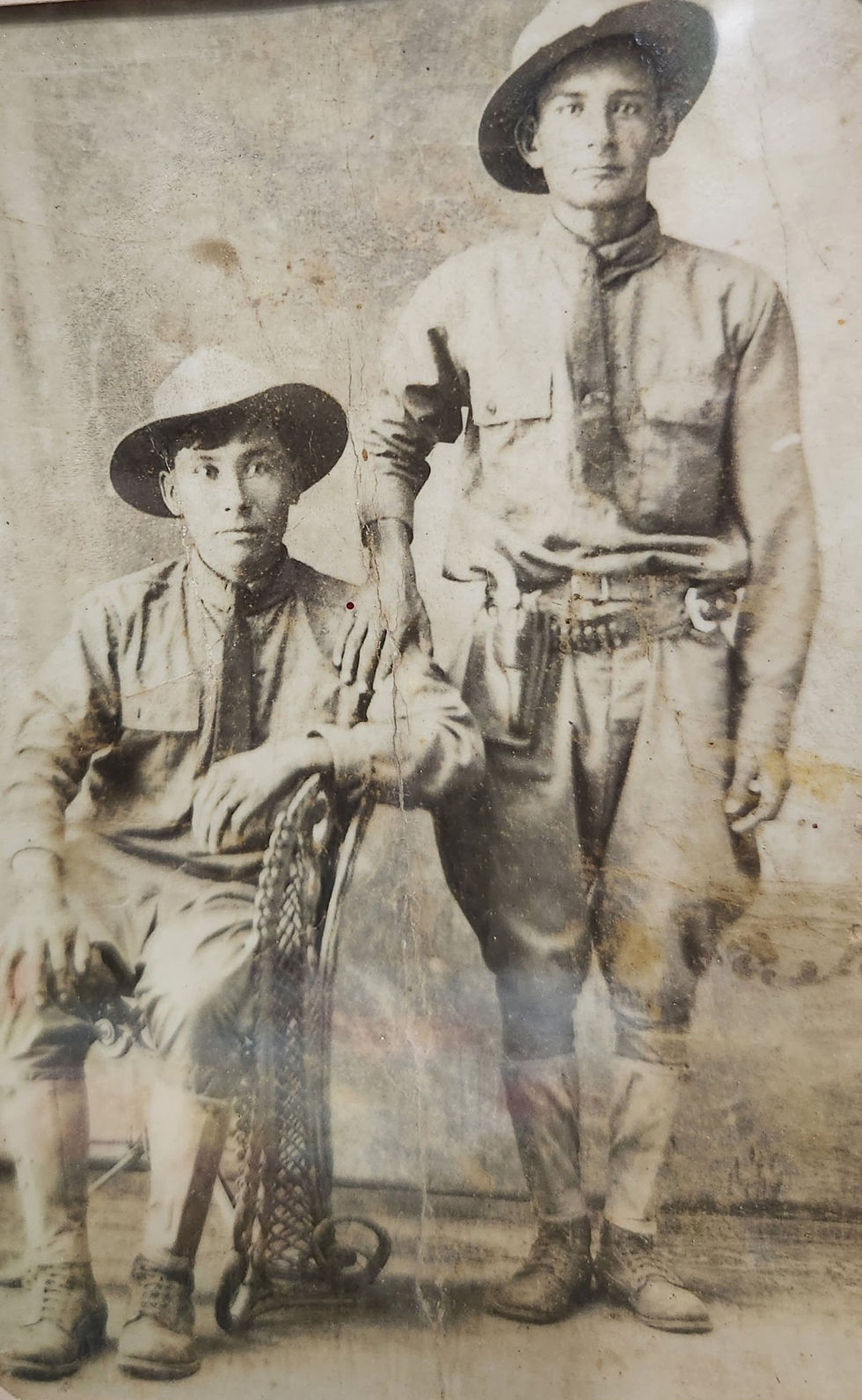
On August 6th, his regiment arrived in Brest, France where they were immediately sent to the 13th Training Area at Bar sur Aube. Soldiers from the U.S. were incredibly "green" compared to the battle-hardened survivors of the French military, who had seen their comrades and country lands bleed relentlessly over the last four years. The 141st and 142nd (from Oklahoma) Infantry Regiments remained there, together comprising the greater 36th Infantry Division. They trained with the French until late September, which is when they mobilized to the front lines to Epernay-Chalons where they acted as reserves for the French. In early October, the entire 36th Division was attached to the Fourth French Army and together they offered relief to the U.S.'s Second Division, the Ninth Division, as well as the 23rd Infantry Division.
As they marched toward the battlefield, the 36th came face-to-face with the harsh reality of what the Great War truly looked like. The Hindenburg Line, which had only been broken a few days earlier on September 29th, showcased the full extent of humanity’s capability for destruction. The 36th navigated around barbed wire entanglements, bodies of soldiers and horses left to rot where they fell, while partially collapsed trenches and large swaths of earth threatened to swallow more souls in gaping maws blown open by artillery shelling. Despite the harrowing sights, the southwestern American soldiers remained steady in their resolve and carried on toward danger.

It was October 8th, 1918 under the command of the French Fourth Army that Amado Robledo and the whole of the 36th would make their mark on history. A massive assault against the German 195th, 213th, and 17th divisions to break their artillery command at Blanc Mont Ridge, a strategic position they had held since the beginning of the war in 1914, was planned. The Battle of Blanc Mont Ridge was no easy feat, as Germany had four defensive lines to hold back the combined arms of the French and U.S. forces. Elevated positioning gave the German Empire a strong advantage with their artillery, shelling essential locations for the Allies and knocking out their field telephones and wired lines. The Germans did not hold back with devastating artillery attacks as the Americans and French advanced up through thick rows of barbed wire toward their machine gun entrenchments.
In the chaos, casualties were quickly piling up and liaison between the 141st and 142nd had completely collapsed. German observation balloons and planes–which occasionally did strafing runs on the exposed infantry–acted as spotters for their artillery while Allied forces struggled to accurately adjust their own artillery. Further complicating matters, the few tanks that the French had deployed were moving behind the infantry, but unable to properly see they fired into the Americans and struggled to make any real progress before they were withdrawn.
With their backs against the wall and no way to communicate across long distances, an innovative group of Indigenous soldiers from southern Oklahoma used their native language to send messages that the Germans had no way of deciphering. These soldiers were the first Choctaw Code Talkers and their messages were instrumental in the Allied Offensive being a success. Though the Allied forces lost around 7,800 men, an overwhelming attack from the left and right flanks of the Ridge resulted in victory for the French and Americans.
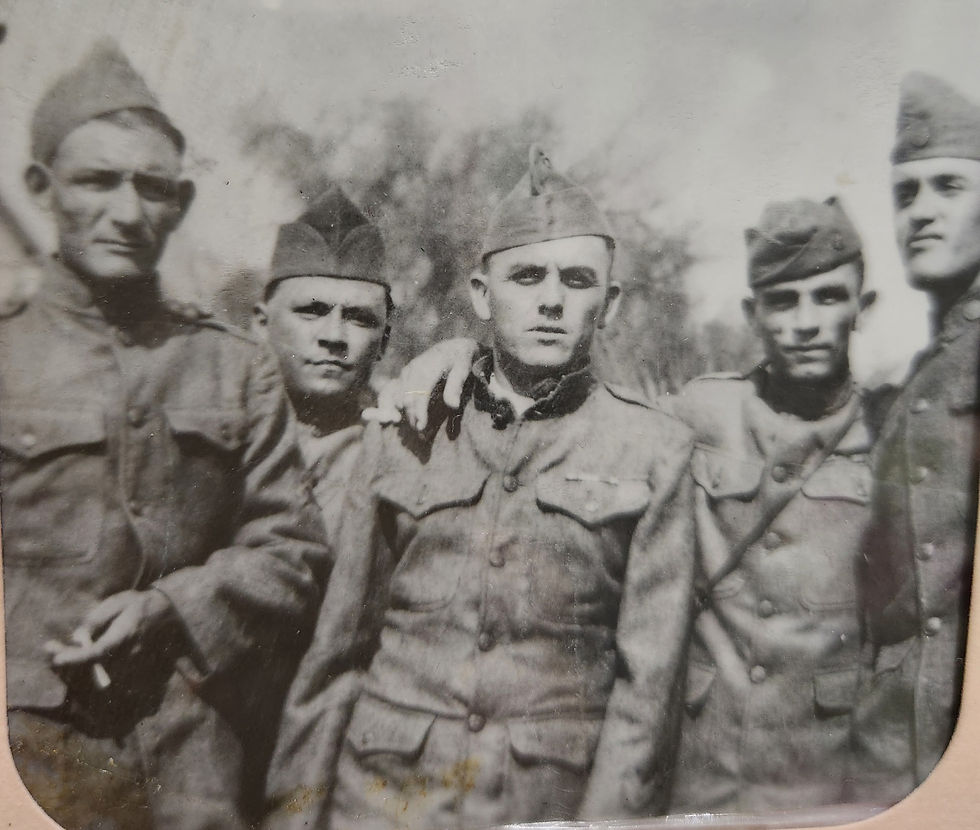
Taking Blanc Mont was a massive turning point in the war for the Western Allies. With Blanc Mont's elevated position above the surrounding largely flat land, artillery could strike at any retaliating Germans in a moment's notice. As a direct result of this bold, risky offensive, the German Empire retreated and withdrew entirely from the Champagne region of France (you're welcome, Madame Clicquot!) Amado Robledo, this lanky kid from Brownsville, had been there not only to witness history, but to make it happen. He was on the front lines for three weeks, holding the line and moving it up with his crew day-in and day-out until the job was done, though he did not leave unscathed. As a direct result of exposure to the poison gas, Robledo would struggle with bloody coughing episodes for the rest of his life.
After the ridge was secured, Private First Class Amado Robledo and the 36th Infantry Division had another major task ahead of them. Though weary and wounded from the capture of Blanc Mont Ridge, the Division only received a single day of rest before they made the 30 mile hike to Forêt-Ferme Hill where Germans had dug into the southern side of the Aisne River. It would be another uphill, mud-caked bloodbath for both sides, but the 36th had made a reputation for themselves as a hardened, reliable unit, and they intended to uphold it. They were a key part of a larger operation called the Meuse-Argonne Offensive, and taking Forêt-Ferme Hill was essential to phase II of the plan.
Through dense woods and deep ravines, the 36th fought their way through Germany’s intense defensive structures and won the day, clearing a path for increased pressure from the United States’ military. I can only imagine the bittersweet mixture of relief and sorrow after overcoming such overwhelming odds at the cost of so many lives. The First World War was unlike any that had come before it; the brave young men who survived the conflict surely left any boyish notions of glory and heroism to drown in the mud.
They did what they had to do. Pride came not with killing or surviving, but with serving the ideals of freedom as they helped to wrest France back into the arms of her people. Following the Battle of Forêt-Ferme Hill, 36th made the 150 mile march back into Allied territory to recover their numbers and prepare for their next orders. The plan was to send them back out on a second combat tour, but thankfully, the 36th never left since the Armistice was signed on November 11th, 1918, putting an end to The War to End All Wars.
Amado Robledo remained in France to help with the recovery until June 3rd, 1919. If I had to guess–and this is purely conjecture–I would imagine this was the time when he met the elusive French girlfriend named Michelle, who made such an impact on him that, even in my limited knowledge, I have heard mention of her. While overseas, Robledo learned that his father had passed away. It was Michelle and her family who helped carry him through this difficult time, and I hope their descendants are doing well. Robledo left the war and Michelle behind in France, returning to the states in June and being honorably discharged on July 4th, 1919. Amado Robledo voluntarily enlisted, served the interests of his country, and played a part in massive strategic victories for the Allies at the end of the First World War.

It's hard to wrap my head around the culture shock that a twenty-year-old from Brownsville felt as he worked with men and women from around the world, but my family has never been one that sits still. There's always more to learn, more to experience, and we will do whatever it takes to leave this world a better place than we found it. Over a hundred years have passed since the Great War ended and it has been decades since Amado Robledo was laid to rest. His legacy is still carried on by his descendants. I'd like to think he's been with us for every champagne toast and will continue to be there until the day comes when we're all clinking glasses on the other side.
God bless family. God bless strange dreams. God bless Amado Robledo.


Comments